Embodied AI Industrial Briefing
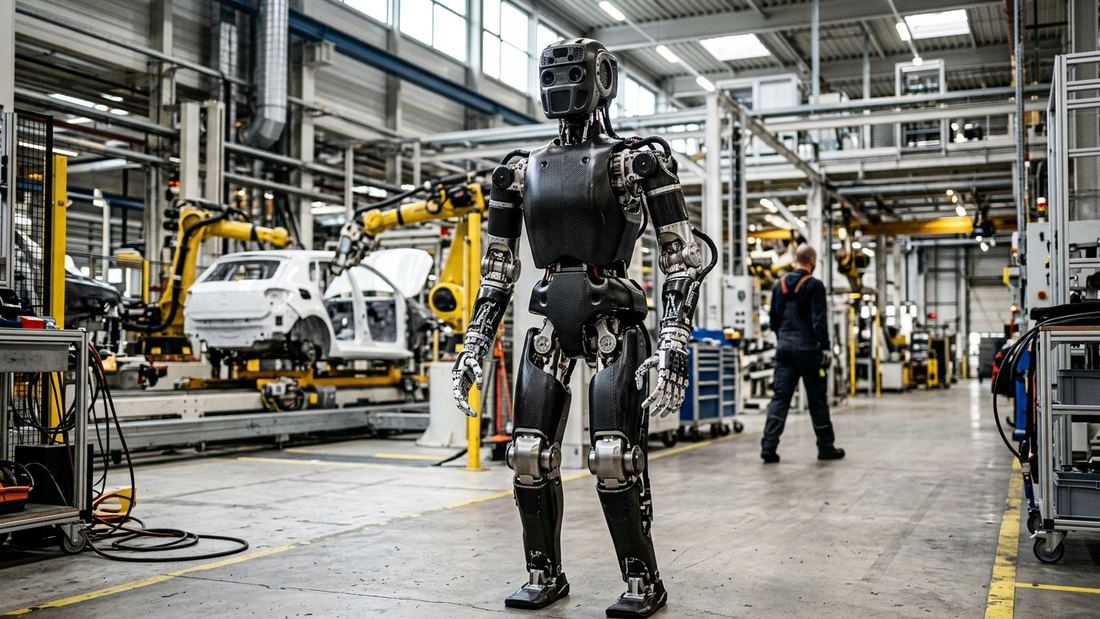
The transition of embodied artificial intelligence from laboratory novelty to commercial reality is occurring at lightning speed. Within commercial manufacturing plants — including BMW’s flagship production facilities — bipedal humanoid platforms such as Figure 02 are executing sub-millimeter sheet metal placement, cable harness routing, and quality assurance inspection entirely driven by unified Vision-Language-Action (VLA) neural networks.
For over fifty years, industrial robotics relied on rigid kinematic scripts. Heavy, caged hydraulic arms repeated hard-coded coordinate paths, blind to their surroundings and hazardous to human operators. The deployment of embodied foundation models has demolished this paradigm, replacing rigid trajectory programming with continuous, generalized visual motor feedback.
1. End-to-End VLA Architectures vs. Modular Stacks
Early humanoid efforts attempted to decompose robotics into distinct modular software silos: visual object detection, inverse kinematics solvers, path planners, and hand motor controllers. This modular approach suffered from compounded latency; by the time the perception module identified a displaced part, the robot’s physical trajectory had already drifted, leading to stuttering movements and fragile grasping.
Figure 02 and modern embodied competitors utilize end-to-end Vision-Language-Action (VLA) foundation models trained on hundreds of thousands of hours of teleoperated human demonstrations. Visual tokens streamed from wide-baseline RGB cameras are directly transformed through cross-attention transformer layers into continuous joint torques at 200Hz.
2. Actuator Engineering and Thermal Dissipation
The true engineering bottleneck of humanoid robotics is not merely software; it is electromechanical efficiency. Figure 02 incorporates custom-designed planetary gear actuators integrated with localized field-oriented controllers (FOC).
- Integrated Hands with 16 Degrees of Freedom: Dexterous manipulation requires tactile finger sensors capable of detecting slip forces at millisecond thresholds.
- Onboard Neural Compute: Dual high-performance edge compute units deliver over 400 TOPS of localized inference, eliminating reliance on external Wi-Fi networks for balance and safety reflexes.
- Continuous Operational Envelopes: Advanced thermal heat-pipe routing through the carbon-fiber exoskeleton enables continuous five-hour shifts between battery hot-swaps.
3. Economic Trajectory: The \$10/Hour Robotic Labor Unit
When amortized over a 3-year commercial lease, the fully-loaded operational cost of an industrial humanoid robot is rapidly approaching \$10 to \$12 per hour. Unlike single-purpose automated machinery costing millions to retool for a new vehicle model year, humanoid platforms adapt instantaneously to new physical factory layouts by merely swapping prompt instructions and demonstration weights. The industrial labor paradigm has entered its most consequential transition since the assembly line itself.
Primary Research Sources & Robotics Documentation
The torque telemetry, vision-language-action (VLA) latencies, sub-millimeter precision tolerances, and automotive manufacturing metrics referenced in this engineering profile originate from official robotics benchmarks and published literature:
- Figure 02 Technical Specifications & Industrial Deployment: Figure AI Official Architecture Release. “Figure 02: Next-Generation Autonomous Humanoid Robot with On-Board Vision-Language-Action Models.” Figure AI Technical Architecture.
- Vision-Language-Action (VLA) Foundations: Brohan, A., Brown, N., Carbajal, J., et al. “RT-2: Vision-Language-Action Models Transfer Web Knowledge to Robotic Control.” Google DeepMind Research (arXiv:2307.15818). arXiv:2307.15818.
- Whole-Body Humanoid Manipulation: IEEE Robotics and Automation Society. “Real-Time Impedance and Torque Telemetry in Bipedal Humanoid Industrial Assembly.” IEEE Transactions on Robotics (T-RO). IEEE Xplore Robotics.