As global supply chains face relentless labor shortages, rising software overhead, and soaring customer fulfillment demands, leading global research firm Gartner has published a definitive roadmap delineating the Four Operational AI Tiers in Warehouse Automation. The research, spearheaded by Gartner’s Supply Chain practice, marks a critical maturation threshold as logistics operators transition from exploratory software pilots to live, facility-wide physical deployments.
Authored by Federica Stufano, Senior Principal Analyst in Gartner’s Supply Chain practice, the report provides enterprise supply chain leaders with a pragmatic framework to evaluate artificial intelligence investments across two fundamental axes: intelligence sophistication and operational action orientation. This framework directly reflects advancements in spatial perception networks and 4D world modeling.
“These four AI trends are interconnected and reflect the evolution of a more intelligent, adaptive, and resilient warehouse environment,” stated Federica Stufano. “Supply chain leaders should take a pragmatic approach to AI in warehousing by tackling proven use cases, such as labour forecasting and slotting, and expanding into generative AI and agents where it can improve decision-making and workforce productivity.”
Macro Industry Catalysts Driving the Shift
According to Gartner’s findings reported by Bloomberg Technology, logistics infrastructure has reached an unprecedented adoption inflection point powered by three interlocking market forces:
- Persistent Workforce Deficits: Warehouses worldwide are grappling with structural labor shortages, high turnover rates in manual picking roles, and escalating hourly wages, making algorithmic efficiency non-optional.
- Lower Initial Software Entry Barriers: Modern commercial software models, including SaaS and Robotics-as-a-Service (RaaS), have dramatically lowered upfront capital expenditure (CapEx), allowing regional distribution centers to access tools once restricted to Fortune 50 giants.
- Production-Grade Autonomous Hardware: Spatial perception sensors, Autonomous Mobile Robots (AMRs), and computer vision pipelines have transitioned from fragile laboratory prototypes into rugged, 24/7 industrial machinery.
The Four Operational AI Tiers: An Architectural Breakdown
Gartner’s model categorizes warehouse automation into four distinct tiers, detailing how systems advance from predictive mathematics to embodied physical robotics:
| Automation Tier | Core Technologies | Operational Workflows | Human Role |
|---|---|---|---|
| Tier 1: Enhanced Optimization | Advanced mathematical solvers, dynamic heuristics, real-time telemetry | Dynamic slotting, demand forecasting, shift planning, travel path routing | Human supervisory review; algorithmic recommendations |
| Tier 2: Operational Generative Planning | Multimodal LLMs, document understanding, unstructured log synthesis | Instant SOP generation, dock delay guides, maintenance archives querying | Technicians assisted by context-rich handheld terminal guides |
| Tier 3: Semiautonomous AI Agents | Agentic planning frameworks, autonomous task redistribution, queue solvers | Dynamic pick-queue balancing, dock bay redistribution, machinery reallocation | Human-in-the-loop override for high-value dispatch sequences |
| Tier 4: Physical AI & Autonomous Robotics | Vision-Language-Action (VLA) models, AMRs, articulated robotic arms, LiDAR | High-speed parcel sorting, automated palletizing, container unloading | Facility-wide fleet managers overseeing autonomous physical fleets |
Tier 1: Enhanced Optimization Models
Traditional static heuristics and rigid spreadsheets are being replaced by high-throughput mathematical engines. By continuously ingesting real-time telemetry from Warehouse Management Systems (WMS), Tier 1 solutions recalculate SKU placement (slotting), pick paths, and personnel allocation dynamically as order volumes fluctuate mid-shift. This curbs deadhead travel distance and lifts overall facility throughput while maintaining strict deterministic audit trails required for compliance.
Tier 2: Operational Generative Systems
Moving beyond structured tabular data, Tier 2 harnesses generative AI to process unstructured facility records: incident tickets, vendor delivery receipts, equipment service logs, and maintenance reports. When unexpected supply delays or dock bottlenecks occur, software agents instantly synthesize context-specific Standard Operating Procedures (SOPs). Floor supervisors receive actionable remediation playbooks directly on handheld terminals without manually searching hundreds of pages of equipment manuals.
Tier 3: Semiautonomous AI Agents
Tier 3 marks the entry into true agentic intelligence. Autonomous software agents continuously monitor warehouse execution queues, identifying emerging bottlenecks before they manifest physically. When picking queues back up at an e-commerce sorting station, the agent automatically redistributes pending picking tasks and directs available workers or automated shuttles across loading bays. Crucially, human facility supervisors retain clear manual override controls over critical operational thresholds.
Tier 4: Physical AI and Embodied Robotics
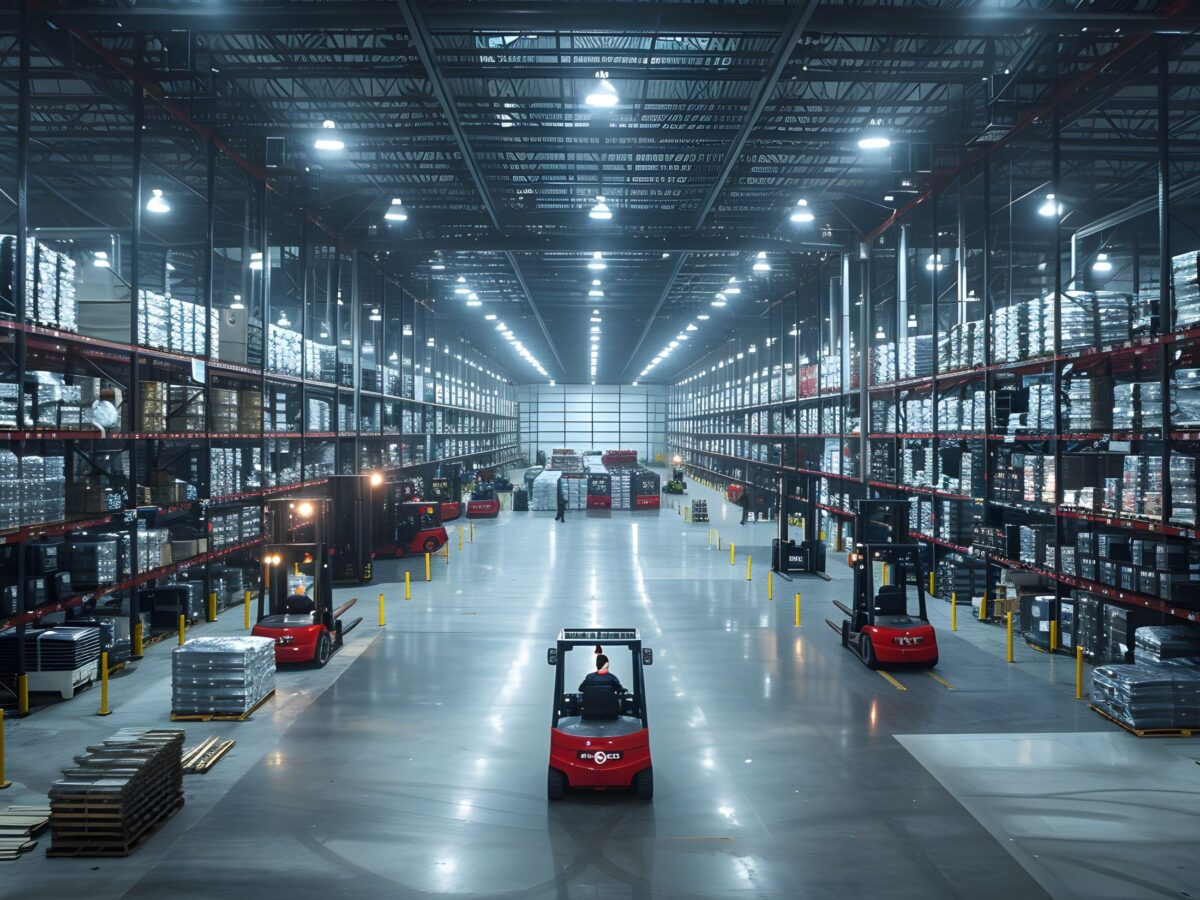
At the apex of the framework lies Physical AI—where multimodal models directly control physical hardware. Autonomous Mobile Robots (AMRs), automated forklifts, and articulated sorting arms equipped with Vision-Language-Action (VLA) foundation models execute precision item picking, mixed-case palletizing, and dock transit. High-speed spatial sensors and depth cameras enable robots to navigate complex, busy warehouse aisles safely alongside human operators.
Strategic Implementation Roadmap for Supply Chain Leaders
Mr. Hozayfa, Lead Technical Analyst & AI Research Scientist at XonoAI, emphasizes the operational wisdom of Gartner’s tiered strategy: “The most common mistake enterprise logistics directors make is attempting to leap directly into full humanoid robotics or complete physical automation without mastering data foundations. Gartner’s four-tier model provides the exact antidote: solidify your Tier 1 dynamic optimization first, layer in Tier 2 generative SOPs for workforce leverage, and gradually introduce Tier 3 and Tier 4 autonomous robotics as operational familiarity matures.”
Conclusion: The Autonomous Facility of Tomorrow
As the boundaries between software optimization and physical robotics blur, warehouse facilities are evolving from static storage depots into highly agile, self-orchestrating logistical engines. By grounding automation strategies in Gartner’s Four Operational AI Tiers, global enterprise operators can achieve resilient throughput, lower operational costs, and build a sustainable supply chain for the decades ahead.