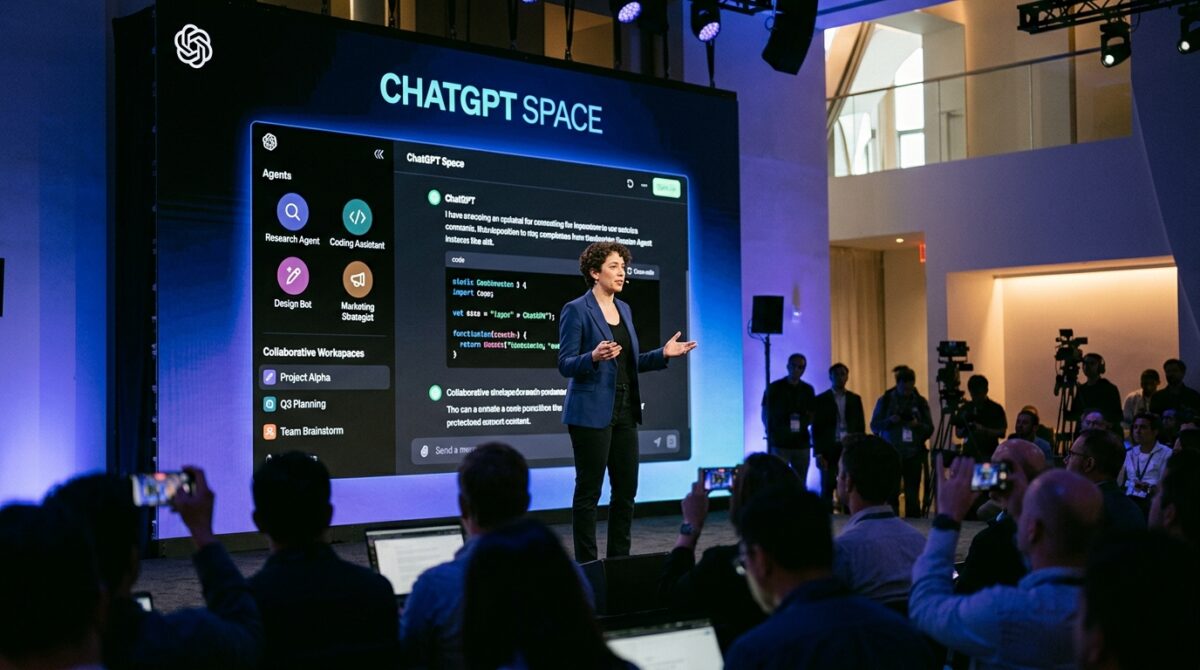
In what marks the most consequential platform transition since the introduction of the modern chat interface in 2022, OpenAI has formally unveiled ChatGPT Space. Debuted during the opening keynote of OpenAI DevDay 2026, the new collaborative operating environment decisively retires the ephemeral, turn-by-turn conversation model. In its place stands an enterprise-grade canvas where distributed human teams, specialized AI models, and autonomous persistent agents collaborate across shared codebases, financial sheets, and live interactive documents.
Key Takeaways & Technical Specifications
- Unified Multi-Agent Hub: Replaces disconnected individual chat histories with unified project workspaces accessible simultaneously by multiple teammates and autonomous AI workers.
- Interactive “Pages” Document Engine: Enables live, bidirectional document and chart co-creation where human engineers and AI models edit side-by-side with full branch history.
- Always-On “Dots” Agent Integration: Connects directly to OpenAI’s newly announced “Dots”—persistent autonomous workers operating inside dedicated virtual machines with 4,000+ app connectors.
- GPT-6.1 Sol Multi-Agent Beta: Introduces root-agent coordination protocols capable of dynamically spinning up subordinate agent workers to tackle parallel engineering tasks.
- Availability & Rollout: Live immediately for ChatGPT Pro, Team, and Enterprise organizations across desktop and web clients.
The End of Ephemeral Chat: Transitioning to Persistent Intelligence
For four years, generative artificial intelligence has been confined to transient chat boxes. Users asked questions, received text completions, and were forced to copy-paste generated artifacts into disparate external software suites like Google Docs, Slack, Notion, or GitHub. ChatGPT Space eliminates this fragmentation by building an active operating system where context is permanently retained and shared across entire business units.
Inside a Space, teammates organize repositories, corporate wikis, raw CSV datasets, and API endpoints into structured domains. When an inquiry or prompt is initiated, the system does not merely generate a paragraph of text; it provisions live interactive canvas modules known as Pages and Collaborative Slides.
“We have spent years teaching artificial intelligence how to hold a conversation. Today, we are giving it a permanent desk in your office,” declared OpenAI Chief Executive Sam Altman during the keynote. “ChatGPT Space is designed from the silicon up for multi-agent execution. You no longer direct one model at a time—you manage an entire swarm of coordinated intelligence that shares your company’s institutional memory.”
Technical Architecture: How ChatGPT Space Coordinates Multi-Agent Swarms
At the architectural core of ChatGPT Space lies a sophisticated root-agent coordination runtime powered by the newly revealed GPT-6.1 Sol model. Designed specifically for high-throughput reasoning and cost-effective execution, GPT-6.1 Sol operates as a central dispatcher:
| Component | Runtime Layer | Execution Capability | Enterprise Latency |
|---|---|---|---|
| Root Dispatcher | GPT-6.1 Sol Orchestrator | Task decomposition, dependency tree generation, subagent delegation | < 180 ms TTFT |
| Persistent Workers | OpenAI Dots Cloud VM | 24/7 background execution, headless browser automation, 4,000+ API calls | Continuous / Event-driven |
| Canvas Layer | Interactive Pages Engine | Multi-user real-time operational transformation (OT), reactive code sandbox | Sub-16 ms rendering |
| Memory Fabric | Enterprise Graph Store | Hybrid vector-lexical indexing over team Slack, Jira, GitHub, and Google Drive | Real-time synched |
When an engineering team instructs ChatGPT Space to “Audit our Kubernetes deployment configurations for security regressions and generate a migration roadmap,” the Root Dispatcher automatically spawns three parallel subagents:
- Codebase Scanner: Clones and parses YAML manifests and Terraform scripts inside an isolated container.
- Vulnerability Auditor: Cross-references dependencies against live CVE feeds and proprietary compliance databases.
- Documentation Agent: Synthesizes findings directly into a live interactive Page, embedding interactive risk charts and executable remediation pull requests.
Integration with “Dots”: Always-On Asynchronous Labor
The linchpin of ChatGPT Space is its deep pairing with Dots, the persistent autonomous agent runtime OpenAI revealed this week. Whereas conventional AI requires human prompts to initiate action, Dots operating within a Space continuously monitor webhooks, incoming customer support tickets, regulatory filings, or software bugs.
If a production server experiences an anomaly at 3:00 AM, the Space-resident Dot receives the telemetry trigger, spins up a debugging session inside Codex Cloud, drafts a pull request with root-cause analysis, and writes a comprehensive incident briefing directly onto the morning triage Page before human engineers even wake up.
Enterprise Security, Sandboxing, and Governance
With multi-agent swarms executing complex actions across enterprise networks, security and governance have taken center stage. OpenAI has addressed enterprise compliance requirements through several dedicated safeguards:
- Granular Role-Based Access Control (RBAC): Administrators can enforce strict permissions dictating which agents can execute read-only queries versus write-enabled transactions.
- Deterministic Action Confirmations: Destructive commands (e.g. database migrations, public API publishing, or financial expenditures) require cryptographically signed human-in-the-loop approvals.
- SOC 2 Type II and HIPAA Compliance: All organizational data ingested into ChatGPT Space is isolated in sovereign tenant partitions and strictly excluded from baseline model pre-training.
Frequently Asked Questions (AEO & Search Verification)
Q: What is the primary difference between ChatGPT Projects and ChatGPT Space?
A: ChatGPT Projects functioned as simple organizational folders for custom instructions and files for individual users. ChatGPT Space is a real-time, multi-user collaborative runtime that supports simultaneous human-and-agent editing, multi-agent parallel execution, and persistent background workers (Dots).
Q: Is ChatGPT Space available for free users?
A: No. ChatGPT Space is currently rolling out exclusively to ChatGPT Pro, Team, Business, and Enterprise enterprise tiers, with expanded developer API endpoints accessible via the OpenAI developer platform.
Q: How does ChatGPT Space handle data privacy for enterprise codebases?
A: Data shared within ChatGPT Space is governed by OpenAI’s enterprise privacy guarantees. Code, uploaded files, and internal conversations are encrypted at rest (AES-256) and in transit (TLS 1.3), isolated within client-specific virtual private clouds, and never used to train public foundation models.