⚡ Executive Summary & Key Insights
- Continuous-Time Dynamics: Unlike traditional neural networks with static weights frozen post-training, Liquid Neural Networks (LNNs) dynamically adjust their state equations in response to streaming environmental inputs.
- Extreme Compute Efficiency: LNN architectures achieve complex autonomous navigation with as few as 20,000 parameters—operating on milliwatt-class edge microcontrollers.
- Out-of-Distribution Robustness: In heavy rain, fog, or unprecedented physical turbulence, LNNs generalize without catastrophic performance collapse.
The Rigidity of Modern Deep Learning
For nearly a decade, the dominant paradigm in artificial intelligence has been dominated by massive scale: train multi-billion parameter Transformer models on static offline datasets, freeze their computational weights, and deploy them across hyperscale cloud clusters. While extraordinarily capable at language generation, this frozen architecture exhibits severe limitations when encountering dynamic, noisy real-world streams like autonomous vehicle sensors, surgical robotics, or high-frequency telemetry.
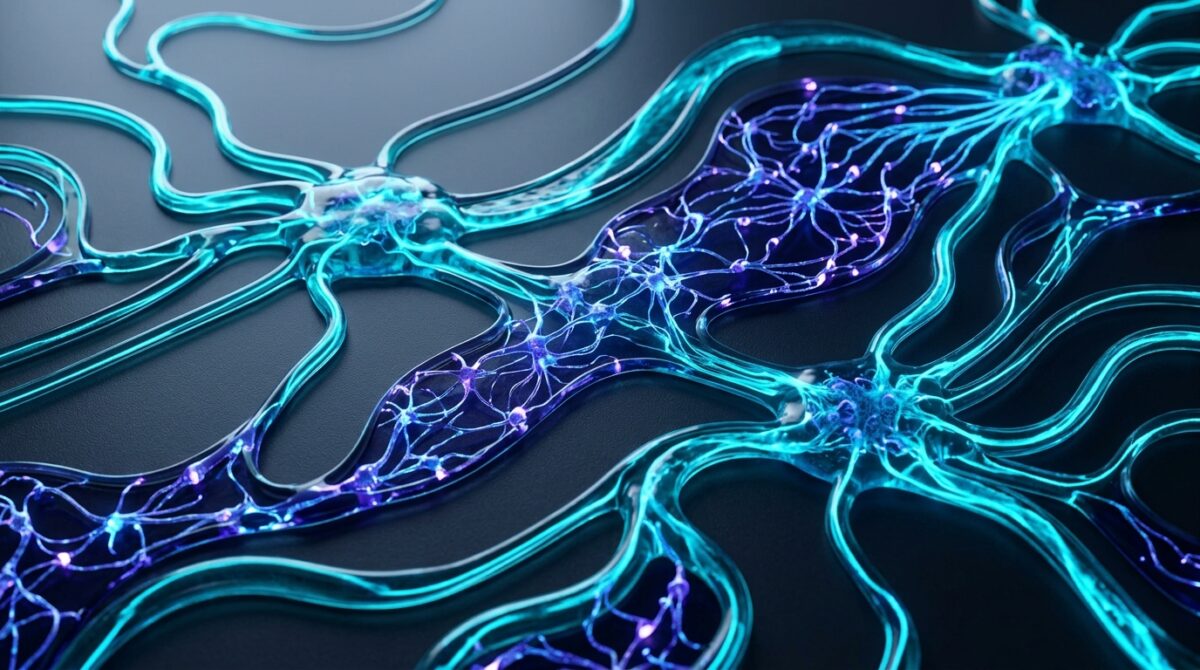
Pioneered by researchers at MIT CSAIL, Liquid Neural Networks (LNNs) introduce a biologically inspired alternative inspired by the microscopic nervous system of the nematode C. elegans.
How Liquid Neural Networks Work: Nonlinear Differential Equations
In a standard feedforward or recurrent network, each neuron computes a discrete weighted sum passed through an activation function ($y = f(Wx + b)$). If the input changes smoothly over time, the network must sample at fixed intervals, making it blind to continuous physical nuances.
Liquid Networks, by contrast, formulate synaptic interactions as continuous-time differential equations:
dx(t)/dt = -[x(t) / τ] + S(x(t), I(t)) × [A – x(t)]
Because the synaptic weights vary as an explicit function of input velocity and temporal context, the network remains fluid—or “liquid”—adapting its behavior in real time without requiring retraining or parameter updates.
Architectural Comparison: Transformers vs. Liquid Neural Networks
| Dimension | Standard Transformer | Liquid Neural Network (LNN) |
|---|---|---|
| Time Representation | Discrete token sequence (fixed intervals) | Continuous time (differential calculus) |
| Computational Footprint | Gigabytes of VRAM (Billion+ parameters) | Kilobytes to Megabytes (10k – 100k parameters) |
| Explainability & Safety | Opaque black-box attention weights | Mathematically auditable state trajectories |
| Edge Deployment | Requires high-power cloud accelerators | Runs locally on microcontrollers & IoT sensors |
Real-World Breakthroughs: Autonomous Drones and Edge Telemetry
In benchmark experiments conducted across dense forest canopies, autonomous drones powered by Liquid Networks were trained exclusively in clear summer weather. When tested in autumn foliage, heavy snow, and unexpected torrential rain, traditional deep networks failed within minutes. The liquid architecture, however, sustained successful navigation without a single navigational collision—autonomously adjusting its internal time-constants to match sensor degradation.
The Future: Hybrid Liquid-Transformer Architectures
Rather than replacing large language models entirely, liquid neural mathematics is being integrated into foundation models to replace quadratic self-attention layers with linear continuous-time blocks. This unlocks infinite context processing while dramatically curtailing memory consumption during real-time streaming.
Frequently Asked Questions (FAQ)
Q1: Can Liquid Neural Networks replace ChatGPT?
Not directly for general conversational writing. LNNs excel at time-series, robotics control, audio streams, and continuous physical systems. However, hybrid models combining both architectures are currently in development.
Q2: Why are Liquid Networks called ‘Liquid’?
Because their internal parameters adapt flexibly to changing input rates and conditions, behaving like a fluid that molds itself to the contours of real-world physical data.