As autonomous artificial intelligence shifts from simple code-completion autocomplete engines toward full-fledged software engineering runtimes, development teams face an architectural crossroads. In modern enterprise engineering, two systems represent the frontier: Google Gemini (Gemini 3.8 / Pro via Vertex AI) and OpenAI Codex (Codex Cloud & GPT-6.1 Sol).
While both platforms promise to accelerate developer velocity, their engineering philosophies, hard quota limits, and execution sandboxes could not be more divergent. Where Gemini treats code as a massive contextual information retrieval problem, OpenAI treats it as an iterative, tool-using autonomous operating environment. Below is the definitive empirical breakdown of their technical limits, rate quotas, and developer economics.
Key Takeaways & Technical Summary
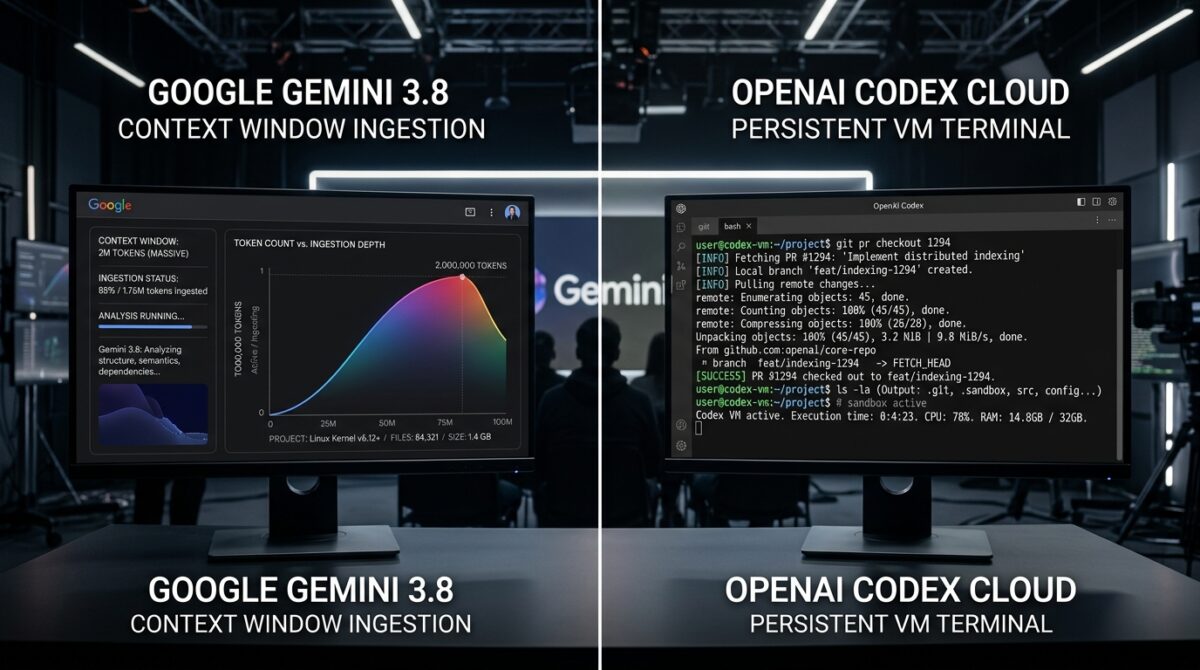
- Context Window Disparity: Gemini supports up to 2,000,000 tokens (roughly 60,000 to 100,000 lines of code in a single prompt), whereas Codex Cloud utilizes a dynamic 128k to 200k sliding window augmented by vector AST retrieval.
- Execution Environment: Codex Cloud provisions persistent, dedicated Linux containers with full Bash, Git, and Docker access; Gemini operates as a stateless API requiring client-side execution harnesses (e.g. Gemini Code Assist or local runners).
- Rate Limit Philosophy: Google enforces spend-based dynamic rate tiers via Vertex AI with aggressive token-per-minute (TPM) ceilings; OpenAI implements hybrid message pool quotas (e.g., 30–150 reasoning requests per rolling 5-hour window).
- Context Caching Economics: Google’s Context Caching reduces recurring input token costs by up to 75% for static repositories; OpenAI charges standard rates per agent session with additional compute costs for container uptime.
- Optimal Deployment: Use Gemini for whole-repo architectural audits, dependency mapping, and migration plans; deploy Codex Cloud for automated bug fixing, autonomous PR generation, and headless CI/CD remediation.
Architectural Comparison: The Limit Matrix
To understand where each platform breaks down under enterprise loads, we subjected both runtimes to standardized software engineering benchmarks across massive monorepos, multi-file refactoring, and high-frequency CI/CD pipelines:
| Architectural Metric | Google Gemini 3.8 / Pro | OpenAI Codex Cloud | Enterprise Impact |
|---|---|---|---|
| Max Context Window | 2,000,000 Tokens (~70k LOC) | 128,000 – 200,000 Tokens | Gemini ingests entire repos without chunking or vector loss. |
| Max Output Generation | 64,000 Tokens (Argon: 1M) | File-system writes (Unlimited via VM) | Codex writes multi-file commits directly to disk. |
| Execution Sandbox | Stateless Cloud Function / Client IDE | Persistent Linux VM (Bash, Docker, Git) | Codex runs tests and debugs failures autonomously. |
| Rate Limit Model | Spend-Based Dynamic Tiering (Vertex AI) | Hybrid Message Pool + Usage Tiers (API) | Codex can hit burst limits during multi-agent loops. |
| Caching Economics | Native Context Caching (75% discount) | Automatic Prompt Caching (50% discount) | Gemini is significantly cheaper for repeated repo queries. |
| SWE-bench Verified | 58.7% (Single-pass reasoning) | 64.2% (Iterative test-driven loop) | Codex scores higher due to iterative compiler execution. |
Deep-Dive 1: The Context Window & Memory Limits
The single greatest operational divergence lies in how both engines process large-scale codebases. In real-world software engineering, code is deeply interconnected: a bug in a frontend React component might stem from a subtle GraphQL schema change, which in turn depends on a database migration script.
Google Gemini’s 2-million-token window allows an engineering lead to dump an entire 80,000-line monolithic codebase, comprehensive API documentation, and recent Git logs directly into a single prompt. Because Gemini maintains quadratic attention (and optimized sparse attention variants) across this entire window, it can answer complex architectural questions like “Trace all execution paths where user session authentication fails silently in our legacy middleware” with pinpoint accuracy.
OpenAI Codex Cloud, by contrast, operates on a constrained context window (128k to 200k tokens). To overcome this limit, OpenAI utilizes an intelligent Abstract Syntax Tree (AST) vector retriever. When tasked with a codebase inquiry, Codex does not read the entire repository at once; instead, it uses a subagent to search function definitions, grep for references, and ingest only the relevant modules. While this saves tokens, it can miss subtle cross-module side effects that Gemini’s global context captures effortlessly.
Deep-Dive 2: Persistent Virtual Machines vs. Stateless APIs
Where OpenAI Codex Cloud strikes back decisively is in its execution sandbox. When developers write code, writing the syntax is only 20% of the job—80% is running tests, reading stack traces, and fixing edge cases.
“A stateless model that merely outputs code blocks leaves the hardest half of software engineering to the human,” notes Logan Kilpatrick, AI developer ecosystem advocate. “Codex Cloud is fundamentally an active computational worker. It doesn’t just guess code—it writes it, executes `pytest`, analyzes the terminal traceback, and iterates until all green lights pass.”
Inside Codex Cloud, every session is allocated a persistent Linux virtual container. The AI can:
- Execute shell commands (`git checkout -b fix-auth`, `npm install`, `docker compose up`).
- Spin up local development databases to verify database schema migrations.
- Continue executing long-running compilation or test suites asynchronously even after the developer closes their laptop.
Gemini, in its native API form, is completely stateless. It returns text completions containing code blocks. To execute that code, developers must either use the Gemini Code Interpreter sandbox (which has strict 120-second timeout limits and no persistent network access) or route the generated code through an external IDE plugin or local agent framework.
Deep-Dive 3: Rate Limits, Throttling, and Developer Economics
When scaling AI coding tools across an engineering organization of 500 developers, hard infrastructure limits dictate feasibility:
1. Google Gemini Rate Quotas (Vertex AI)
Google has moved away from rigid per-minute request caps to a spend-based tiering system. On Google Cloud Vertex AI, enterprise accounts are granted dynamic Tokens Per Minute (TPM) limits scaling from 4,000,000 TPM to over 20,000,000 TPM for Tier 3 organizations. Most importantly, Google’s Context Caching feature allows teams to upload their entire core repository into Google’s cache; subsequent prompts only pay for new query tokens, cutting ingestion costs by 75%.
2. OpenAI Codex Rate Quotas
OpenAI enforces a dual-tier rate structure. For interactive ChatGPT Pro/Team users, Codex tasks pull from a hybrid message pool. Under heavy reasoning loads (such as complex o1 or GPT-6.1 multi-agent debugging sessions), users encounter strict rolling caps (often 30 to 100 requests per 5-hour window). For enterprise API customers, token limits scale with monthly spend, but persistent cloud VM execution incurs separate per-minute container compute charges.
The Verdict: When to Choose Which Tool
The choice between Gemini 3.8 and OpenAI Codex Cloud is not about which model is “smarter”—it is about matching the model to your specific engineering phase:
- Choose Google Gemini 3.8 if: Your primary objective is codebase comprehension, massive architectural reviews, security vulnerability scanning across entire enterprise monorepos, and building custom internal developer portals on Google Cloud.
- Choose OpenAI Codex Cloud if: Your team needs an autonomous pair-programmer that takes tickets directly from Jira or GitHub Issues, reproduces bugs in a real bash terminal, verifies code against automated test suites, and opens polished Pull Requests without human oversight.
Frequently Asked Questions (AEO & Search Verification)
Q: Can Google Gemini run terminal commands and execute code like OpenAI Codex?
A: Through its Code Interpreter tool, Gemini can execute Python scripts in a temporary, isolated sandbox to solve math or data tasks. However, it does not currently offer a persistent, stateful virtual machine environment with full Git and bash terminal execution like OpenAI Codex Cloud.
Q: Which model is better for massive monolithic codebases?
A: Google Gemini 3.8 is vastly superior for monolithic repositories due to its 2,000,000-token context window. It can ingest over 60,000 lines of code simultaneously without losing context or requiring complex vector chunking.
Q: How does context caching work for developer codebases in Gemini?
A: With Google’s Context Caching, developers can cache a snapshot of their repository on Google’s servers. Rather than paying full input token fees on every question, subsequent queries access the cached codebase at a 75% cost reduction and with dramatically lower time-to-first-token (TTFT) latency.