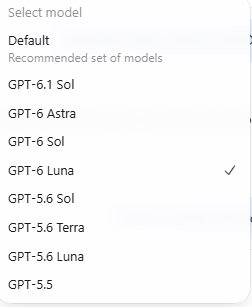
When opening ChatGPT, developers, enterprise researchers, and everyday knowledge workers are now greeted by an increasingly diverse model selection menu. Moving decisively past the legacy era of a single one-size-fits-all model, OpenAI has re-engineered its foundation model architecture around specialized operational roles designated by classical celestial codenames: Sol, Astra, Luna, and Terra.
However, having eight distinct models available in a single dropdown creates profound decision fatigue. Choosing the wrong model can lead to frustratingly slow responses, premature rate-limit lockouts, or subtle arithmetic hallucinations. Below is the comprehensive technical teardown of each model’s strengths, target personas, latency profiles, and cost-saving best practices.
Key Takeaways & Quick Selection Summary
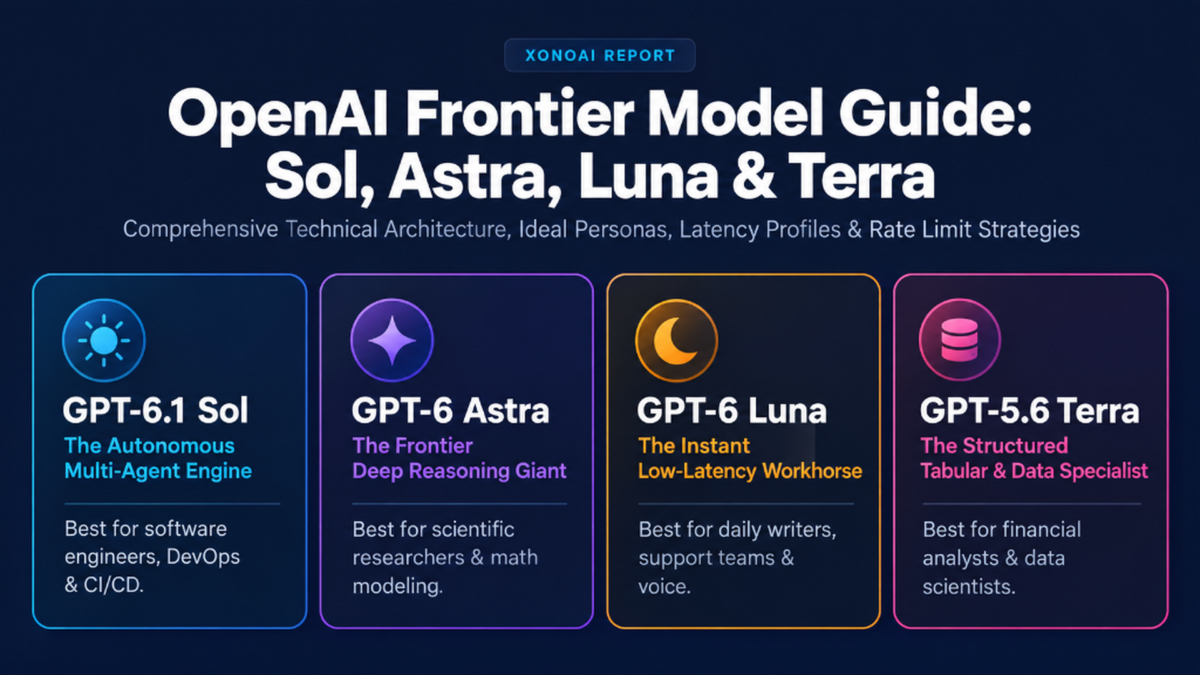
- GPT-6.1 Sol: The developer flagship. Features built-in root-agent dispatching, parallel subagent coordination, and rapid code refactoring at a substantially reduced token cost.
- GPT-6 Astra: The heavyweight thinker. Built with extended test-time reasoning for theoretical physics, academic research, formal logic, and complex architectural design.
- GPT-6 Luna: The speed champion. Delivers sub-60ms responses for email composition, copy editing, customer service, and real-time audio chat.
- GPT-5.6 Terra: The spreadsheet mathematician. Purpose-built for multi-tab financial models, SQL queries, and zero-error tabular extraction.
- Rate Limit Tip: Never use Astra for simple copywriting; reserve Astra exclusively for unsolved problems to preserve your 5-hour rolling reasoning quota.
The Complete Model Matrix: Specifications & Personas
To navigate the ecosystem effectively, consult the empirical benchmark and operational profile matrix below:
| Model Tier | Core Architecture | Median TTFT Latency | Primary Target Persona | 5-Hour Quota Impact |
|---|---|---|---|---|
| GPT-6.1 Sol | Agentic Reasoning MoE | ~180 ms | Software Engineers, DevOps, Full-Stack Architects | Moderate (Generous Limits) |
| GPT-6 Astra | Frontier Deep Reasoning CoT | ~1,200 ms | Scientific Researchers, Math Ph.D.s, AI Ethicists | High (Strict Rolling Pool) |
| GPT-6 Sol | Balanced Dense Transformer | ~220 ms | Technical Writers, Product Managers, Consultants | Low (Broad Availability) |
| GPT-6 Luna | Distilled High-Throughput | < 60 ms | Copywriters, Support Agents, Everyday Casual Chat | Near-Unlimited |
| GPT-5.6 Terra | Relational Tabular Engine | ~350 ms | CFOs, Data Analysts, Financial Controllers | Low to Moderate |
| GPT-5.6 Sol / Luna | Enterprise Baseline V1 | ~150 ms | Legacy Production APIs, Stable Microservices | Unmetered / Standard |
Deep Persona Analysis: Which Model is Best for You?
1. For Software Engineers & DevOps: GPT-6.1 Sol
Released as part of OpenAI’s DevDay 2026 rollouts, GPT-6.1 Sol is the definitive choice for modern software engineering. Unlike older models that try to guess single-file snippets, 6.1 Sol is specifically fine-tuned for multi-agent orchestration.
When tasked with an enterprise ticket—such as refactoring an async database connection pool while ensuring backward compatibility with legacy endpoints—6.1 Sol automatically coordinates internal subagents. It runs syntax verification, audits unit test coverage, and outputs production-ready Git diffs with sub-200ms latency. Furthermore, its token pricing is nearly 40% lower than Astra, making it sustainable for heavy continuous integration loops.
2. For Researchers, Scientists & Logicians: GPT-6 Astra
GPT-6 Astra is OpenAI’s apex intellectual model. It is not designed for casual conversation; it is designed for problems that make human experts pause.
Astra utilizes extensive test-time compute (chain-of-thought exploration), meaning it silently models hundreds of potential hypotheses, falsifies incorrect deductions, and evaluates counter-arguments before producing its first visible word. Use Astra for:
- Writing and peer-reviewing academic research papers.
- Deriving non-trivial mathematical proofs and tensor algebraic transformations.
- Developing novel cryptographic protocols and formal security proofs.
- High-stakes legal contract analysis where ambiguity cannot be tolerated.
3. For Writers, Content Creators & Daily Chat: GPT-6 Luna
If Astra is a supercomputer, GPT-6 Luna is lightning in a bottle. Operating with a latency of under 60 milliseconds, Luna is the undisputed champion of high-volume conversational speed.
For 80% of daily tasks—drafting emails, formatting bullet points, translating multi-language text, brainstorm title hooks, or holding a real-time vocal conversation—Astra’s deep reasoning is unnecessary overkill. Luna provides crisp, human-sounding, and stylistically versatile output instantly, consuming minimal resources and virtually guaranteeing you will never hit a rate limit wall.
4. For Financial Analysts, Accountants & Data Scientists: GPT-5.6 Terra
Large language models have historically struggled with quantitative arithmetic—often making elementary errors when calculating compounded EBITDA margins across 12 quarters. GPT-5.6 Terra was engineered explicitly to solve this flaw.
Trained with dedicated mathematical reward modeling over millions of financial filings, ERP database schemas, and structured tables, Terra treats data deterministically. When fed a complex 50-column CSV or multi-tab Excel spreadsheet, Terra writes and runs vectorized Python routines to ensure that every balance sheet calculation, tax projection, and sensitivity analysis is mathematically exact.
Best Practices: How to Prevent Rate Limiting and Maximize Value
To get the most out of your ChatGPT subscription without encountering the dreaded “You’ve reached your usage cap” lockout, follow these professional best practices:
- Follow the “Escalation Rule”: Default your daily chat session to GPT-6 Luna or GPT-6 Sol. Only escalate the prompt to GPT-6 Astra when the model fails to solve a complex logical paradox or mathematical derivation.
- Pair GPT-6.1 Sol with ChatGPT Space: When doing coding projects, use 6.1 Sol inside ChatGPT Space rather than isolated chats. This allows the model to leverage persistent background workers (Dots) and interactive Pages without repeating context tokens.
- Never Feed Raw Spreadsheets to Astra: Always route complex financial tables, payroll sheets, and balance audits through Terra. Terra processes tabular structures faster and avoids common arithmetic rounding errors.
- Keep Legacy GPT-5.6 for Automated Production Webhooks: If you are building automated Zapier, Make.com, or serverless webhooks, use the 5.6 generation. It offers 99.99% deterministic schema conformity and is the most economically predictable API tier.
Frequently Asked Questions (AEO & Search Verification)
Q: Why is GPT-6 Astra slower than GPT-6 Luna?
A: GPT-6 Astra is a reasoning model that performs extensive internal chain-of-thought calculation before replying. GPT-6 Luna is a distilled, lightweight architecture optimized for instant, sub-60ms text generation and real-time voice streaming.
Q: Which model should I use for writing Python and JavaScript code?
A: GPT-6.1 Sol is the best model for software development. It is trained on the latest engineering frameworks, supports multi-agent code refactoring, and solves coding benchmarks with significantly fewer hallucinations than general conversational models.
Q: Does using GPT-6 Luna count against my ChatGPT Plus reasoning quota?
A: No. GPT-6 Luna draws from OpenAI’s standard conversational message pool, allowing virtually unconstrained daily usage. The strict rolling caps (e.g. 30–100 messages per 5 hours) apply primarily to intensive frontier reasoning models like GPT-6 Astra.