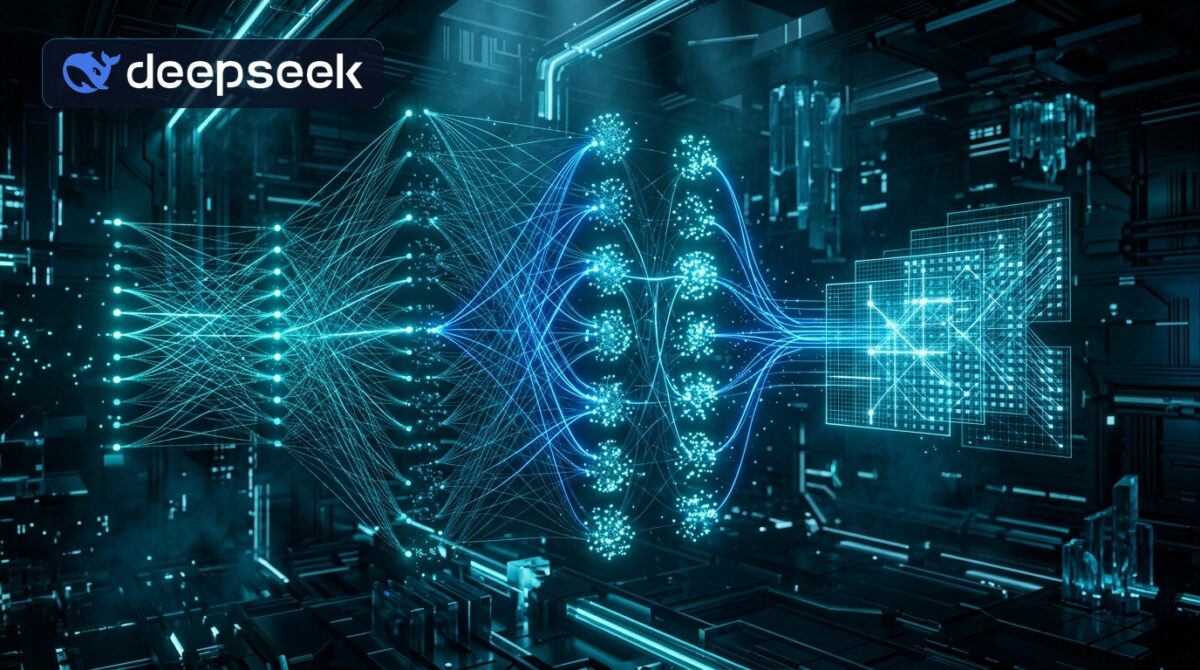
DeepSeek-V3 represents a paradigm shift in open-weights Mixture-of-Experts (MoE) design, scaling to 671 billion total parameters with 37 billion active per token while circumventing the bandwidth bottlenecks and training instabilities that have historically crippled ultra-wide distributed LLMs. By combining Multi-Head Latent Attention (MLA) with an innovative auxiliary-loss-free load balancing mechanism and a natively optimized FP8 mixed-precision training framework, DeepSeek-V3 achieves training throughputs and inference efficiencies that rival proprietary frontier systems at a fraction of the capital expenditure.
Deconstructing Multi-Head Latent Attention (MLA)
Traditional transformer architectures rely on Multi-Head Attention (MHA) or its variants like Grouped-Query Attention (GQA) to maintain expressivity. However, standard Key-Value (KV) cache memory footprints scale linearly with context length and batch size, creating a severe memory bandwidth wall during autoregressive generation. DeepSeek-V3 solves this through Multi-Head Latent Attention (MLA), which compresses the KV cache into a low-rank latent vector space before generation and reconstructs them dynamically on the fly.
Unlike standard low-rank approximations that sacrifice retrieval fidelity, MLA couples the compression mechanism with decoupled rotary position embeddings (RoPE). By maintaining absolute position encodings outside the compressed latent space, MLA prevents the positional degradation typically observed in compressed KV caches. The mathematical formulation compresses the high-dimensional KV tensors $W^{K}$ and $W^{V}$ into a compact latent vector $c_t^{KV}$ of dimension $d_c ll h cdot d_h$, drastically reducing the KV cache footprint per token.
- KV Cache Compression: Reduces memory footprint by up to 93.3%, allowing for massive context windows without exhausting HBM capacity.
- Decoupled RoPE: Isolates positional encodings to preserve spatial and temporal retrieval accuracy across long-context inputs.
- Inference Acceleration: Minimizes memory-bound kernel execution times, significantly improving tokens-per-second throughput on clusters of NVIDIA H800/H100 accelerators.
“MLA is not merely a memory optimization; it is a structural redesign of the attention mechanism that reconciles the tension between long-context capacity and hardware memory bandwidth.” — Lead Systems Architect, XonoAI Intelligence
Auxiliary-Loss-Free Load Balancing in MoE Routing
Mixture-of-Experts routing algorithms traditionally rely on auxiliary losses (such as load balancing loss and router z-loss) to prevent token collapse, where a small subset of expert networks are over-utilized while others remain dormant. While effective at forcing uniform distribution, auxiliary losses artificially penalize the router, degrading downstream task performance and perplexity.
DeepSeek-V3 introduces a novel auxiliary-loss-free load balancing strategy. Instead of injecting a gradient-penalizing loss term into the primary objective function, the framework dynamically adjusts a bias term added to the router’s logits for each expert based on historical routing counts. If an expert processes an abnormally high volume of tokens within a sliding window, its bias is decremented; under-utilized experts receive an incremented bias.
| Architecture Parameter | Traditional MoE (Standard) | DeepSeek-V3 MoE |
|---|---|---|
| Total Parameters | Varies (70B – 500B) | 671 Billion |
| Active Parameters per Token | 12B – 16B | 37 Billion |
| Routing Loss Mechanism | Auxiliary Load Balancing Loss | Auxiliary-Loss-Free Dynamic Bias |
| KV Cache Optimization | Standard MHA / GQA | Multi-Head Latent Attention (MLA) |
| Native Training Precision | BF16 / FP16 | FP8 Mixed Precision Framework |
FP8 Mixed Precision Training Infrastructure
Scaling models past half a trillion parameters introduces staggering interconnect and compute challenges. DeepSeek-V3 pioneers a robust FP8 mixed-precision training pipeline designed to mitigate the numerical instability inherent in lower-precision floating-point formats without sacrificing convergence rates.
The framework implements fine-grained quantization strategies, segregating tensors into micro-blocks to compute scaling factors dynamically. This prevents gradient underflow and overflow in the lower-mantissa FP8 representations. Furthermore, DeepSeek-V3 utilizes custom CUDA kernels that fuse quantization, activation, and communication primitives, drastically overlapping network communication across InfiniBand fabrics with raw tensor computations.
- Fine-Grained Quantization: Applies dynamic scaling across sub-tensor blocks to preserve outlier precision.
- Dual-Precision Accumulation: Retains high-precision FP32 formats for critical reduction steps while executing core matrix multiplications in high-throughput FP8.
- Communication Overlap: Hides MoE all-to-all communication latency behind localized FP8 GEMM operations.
Enterprise Deployment Implications and Strategic Outlook
For Chief Technology Officers and enterprise systems architects, DeepSeek-V3 signifies a structural shift in infrastructure economics. The combination of MLA and FP8 training dramatically lowers the hardware barrier to hosting state-of-the-art frontier models. Enterprises can now deploy a 671B parameter architecture with inference hardware footprints previously reserved for models one-fourth its size.
However, extracting optimal performance from DeepSeek-V3 requires specialized runtime engineering. Standard inference frameworks lack native support for MLA cache reconstruction and fine-grained FP8 MoE routing kernels. Organizations must invest in custom tensor-parallel orchestration layers and ensure underlying cluster fabrics support high-bandwidth, low-latency inter-node communication to prevent all-to-all bottlenecks. As multi-agent systems and agentic runtimes demand higher context windows and instantaneous inference, architectures like DeepSeek-V3 establish the blueprint for enterprise-grade autonomous compute infrastructure moving forward.